I’m Here, but Nothing

Year: 2000
Material/Technique: Others
Size: -
Edition: Unique
Signed:Not Set

About the Work
- Year
- 2000
- Material/Technique
- Others
- Size
- -
- Edition
- Unique
- Signed
- Not Set
- Credits
- photo credit: William Gomes
- Frame
- Not Included
- Work Certificate
- Not Set
- Category
- Installation
- Style
- Others
Work Details
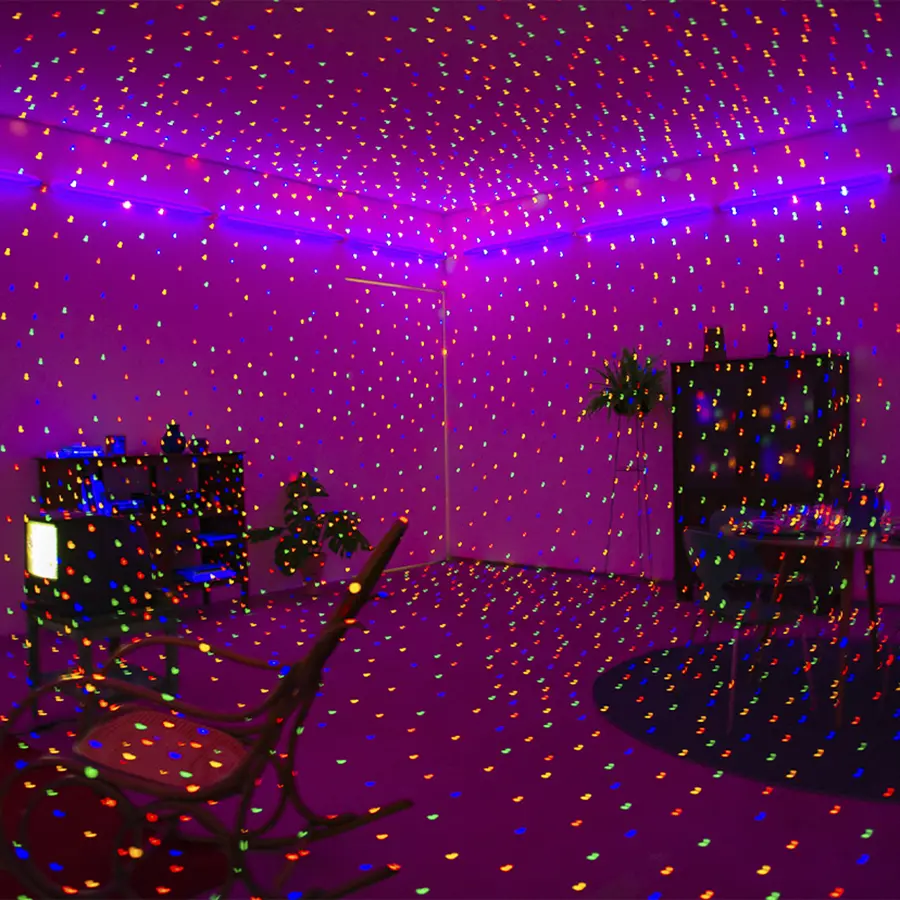
1967年に映画『Self Obliteration』で行ったパフォーマンスにおいて、草間彌生は初めて絵の具と蛍光灯を使い、点や体の一部の要素を反復することによって、自身が見ている世界を可視化した。人物をキャンバスとして絵画を制作した後、《I’m Here, But Nothing》のように、没入型の環境によって知覚を変化させていく。本インスタレーションでは、ごく普通の部屋に、鮮やかな色彩のドットを散りばめられ、それをブラックライトが照らし出す。部屋に入ると、タイトルが暗示するように、誰かがドアを通って入ろうとしているかのように感じるが(I’m Here)、誰もいない(But Nothing)。そこでは、逆説的だが、充足が空虚に耐えうること、充足と空虚の概念の近さを知覚するのである。
幼少期にドローイングを描いて以来、草間彌生の作品は反復するパターンを特徴としてきた。草間は、1950年代後半にニューヨークで行った初の展覧会で、キャンバスに無数のドットを用いた、大規模な絵画を発表したことで知られるようになった。様々な素材や言語を用いて実験的な試みを重ねるなかで、当時の保守的な文脈にしては大胆な芸術的プロジェクトを展開していく。彼女のキャリアに共通しているのは、個から離れ、宇宙と一体化する「自己忘却 (Self Obliteration)」の概念である。それは、 私たちが何か大きな全体の一部であるということを気づかせてくれる。
In a performance in 1967, during the presentation of the film Self-Obliteration, Yayoi Kusama resorted to paint and fluorescent lamps for the first time to lend visibility to her perception of the world, making repetitive use of elements such as dots, and body parts. After using people as canvases for her paintings, the artist began to transform perceptions through immersive environments, as in I'm Here, But Nothing. In this installation, Kusama creates an ordinary domestic room, but illuminated by black light and peppered with vibrantly colored dots. As we enter the room, part of the title (I'm Here) seems to imply that the artist or someone is about to enter through the door. Paradoxically, one perceives the absence (But nothing) and the notion of proximity that the concept of fullness can bear of the empty.
Repetitive patterns have marked Yayoi Kusama's artistic career since the drawings made in her childhood, but it was at one of her first exhibitions in New York (USA), in the late 1950s, that she became known for her large-scale paintings with myriad monochromatic dots on canvas. As she experimented with a series of mediums and languages, the artist elaborated increasingly audacious artistic projects for the conservative context of that time, in which she manifested-herself politically and proposed the liberation of the body through happenings and performances. A common thread running through the entire course of her career has been that of the concept of self-obliteration, which consists of relinquishment of individuality to become one with the universe. Thus, Kusama reminds us that we are connected by something greater and that we are part of a whole.
Em uma performance em 1967, durante a apresentação do filme Self-Obliteration [Auto-Obliteração), Yayoi Kusama usou pela primeira vez tinta e lâmpada fluorescentes para tornar visível sua percepção de mundo que passa pela repetição de elementos como pontos e partes do corpo. Depois de usar pessoas como telas para suas pinturas, a artista passa a transformar a percepção por meio de ambientes imersivos, como em I'm Here, But Nothing (Estou aqui, Mas nada]. Nesta instalação Kusama cria uma sala doméstica comum, mas ilu-
minada por luz negra e salpicada por pontos brilhantes coloridos. Ao entrarmos, como parte do título indica (Estou aqui) a artista ou alguém parece estar prestes a entrar pela porta.
Paradoxalmente, percebe-se a ausência (Mas nada) e a noção da proximidade que o conceito de cheio pode ter do vazio.
Os padrões repetitivos marcam a trajetória de Yayoi Kusama desde os desenhos feitos na infância, mas foi em uma de suas primeiras exposições em Nova York (EUA), no final da década de 1950, que ficou conhecida por suas pinturas de grande escala com infinitos pontos monocromáticos sobre tela. À medida que experimentava uma série de suportes e linguagens, a artista elaborava projetos artísticos cada vez mais audaciosos para o contexto conservador da época, em que se manifestava politicamente e propunha a libertação do corpo por meio de happenings e performances. Em sua longa carreira, uma ideia conecta o conjunto da sua obra, o conceito de auto-obliteração, que consiste na abolição da individualidade para tornar-se um com o uni-
verso. Assim, Kusama nos lembra que somos conectados por algo maior e que fazemos parte de um todo.
Support art institutes temporarily closed due to the COVID-19 pandemic
支援できる美術館はこちら
Below is a link to the art institute that you can support
Exhibition Information
- Current Exhibition
- ArtSticker Brazil05.18.2020 - 05.18.2099
Artist

Artist
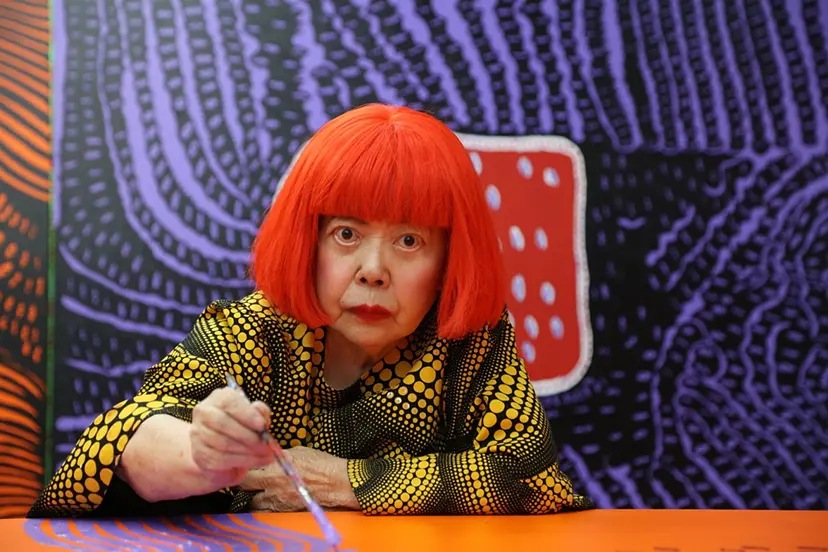
Japanese, b.1929 Avant-garde Japanese artist Yayoi Kusama was an influential figure in the postwar New York art scene, staging provocative happenings and exhibiting works such as her “Infinity Nets,” hallucinatory paintings of loops and dots (and physical representations of the idea of infinity). Narcissus Garden, an installation of hundreds of mirrored balls, earned Kusama notoriety at the 1966 Venice Biennale, where she attempted to sell the individual spheres to passersby. Kusama counted Donald Judd and Eva Hesse among her close friends, and is often considered an influence on Andy Warhol and a precursor to Pop art. Since her return to Japan in the 1970s, Kusama's work has continued to appeal to the imagination and the senses, including dizzying walk-in installations, public sculptures, and the "Dots Obsessions" paintings.
See artist information