Bus Stop Art Project in TAKATO

Year: 2020
Material/Technique: Paint, Wood
Edition: Not Set
Signed:Not Set
About the Work
- Year
- 2020
- Material/Technique
- Paint, Wood
- Edition
- Not Set
- Signed
- Not Set
- Credits
- 【制作協力】 高遠第二第三保育園と地域の未来を考える会 高遠に住む皆様 東京藝術大学 【写真】 高橋博正(山の上スタジオ)
- Frame
- Not Set
- Work Certificate
- Not Set
- Category
- Project
- Style
- Everyday
Work Details
About Takato bus stop art
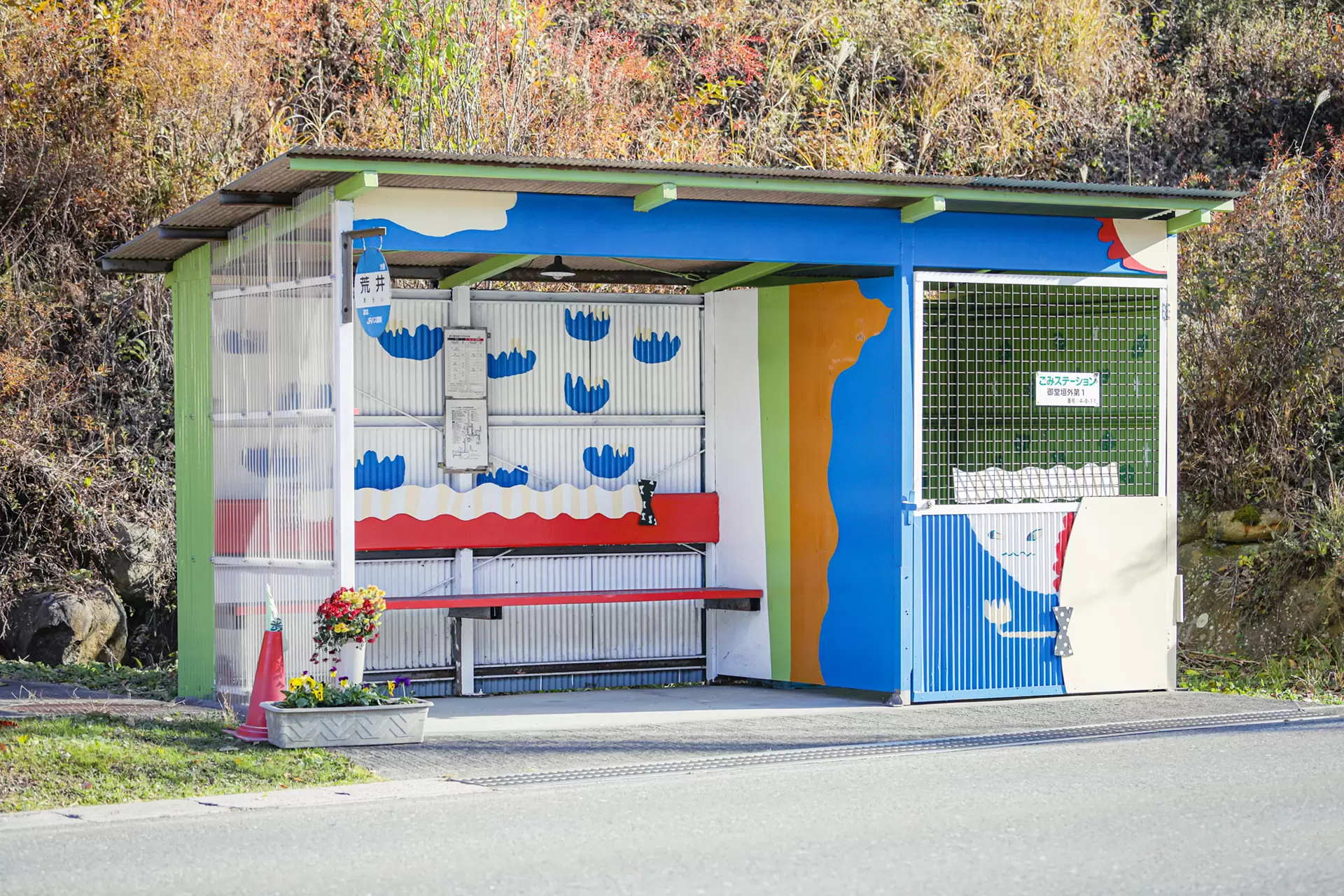
From 2019/3 to 2020/9, we carried out a project to turn the bus stop in Takato-cho, Ina City, Nagano Prefecture into a work of art. It is a regional revitalization project aimed at providing opportunities for residents to enjoy art more closely and fostering attachment to the region by placing works of art in spaces rooted in daily life.
Of the 39 bus stops on the Fujisawa to Chino Line from the Ina branch of JR Bus Kanto, 23 of which have waiting areas have been renovated and turned into works of art. The main body of the waiting area has been repainted at 22 locations, and works have been installed at 1 location.
The overall theme of the work is to create an entity that watches over the region, like the stone Buddha of Takato Masonry. Since the Edo period, masonry craftsmen have been active in the Takato region who excavated stones and made stone Buddhas and pagodas. I hope that the bus stop will be like Ishibutsu in Takato, and that it will be a place that watches over the residents from along the Fujisawa Line. Also, every bus stop was individually designed based on interviews with residents. When deciding on the theme for each bus stop, we stood from the viewpoint of the residents and avoided motifs often used in the tourism industry, such as “cherry blossoms” and “castles.” This is because from coverage and exchange with the region, I felt that there are already large tourism resources called cherry blossoms and history, and that the entire town is required to unite and revitalize rather than economic benefits.
In addition to myself, the production was carried out with the full cooperation of my assistant friend, the “Association for the Future of Takato Second and Third Nursery Schools and the Community.”
Production process
The first meeting was held in Takato on 2019/3/27, and interviews were conducted with museum curators, deepened understanding of the Takato area, and examined the concept of a bus stop. Over the next half year, discussions were repeated about the scale and design of the work, budget, how to obtain permission, interviews with local people, and how to proceed, and production began in 2019/10. From October 2019 to January 2020, I stayed in Takato for over half a month and continued production. In February, when the cold became severe, I made cushions and parts for the work to be placed at the bus stop at my home in Chiba. From March 2020, the novel coronavirus spread during my stay, and since I refrained from moving to Chiba where my home is located, I unexpectedly decided to stay until June.
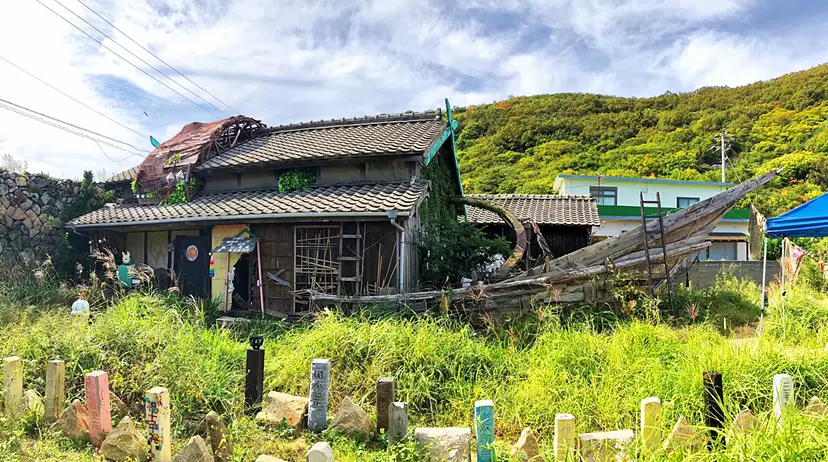
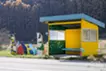
After that, construction of the last bus stop in front of Takato Elementary School was completed in September, and it was completed. The photo shows what the bus stop looked like before the renovation and a production record at that time.
Production location and food
An old private house called the “Shioku House” was used during the production period. In this house, which has a history of over 100 years, the bathroom, toilet, and part of the rooms on the first and second floors were remodeled, and workshops and exchange meetings were held as a place where the “Association to Think About the Future” interacted with Tokyo University of the Arts. The entrance has an earthen floor, and the attic on the second floor has a high-ceiling space that was once used for sericulture, and there is a staircase at the end of the hallway on the other side, leading to the separation. The summer was so cool that no air conditioning was needed, but the winter was so cold that we used 2 oil stoves per room. I used to use the bath by putting kerosene in the boiler outside. In December, an outdoor water pipe froze and burst due to the cold, and based on this situation, I rented a room in the house of an acquaintance's pottery family and lived in and made it in January.
The production site used a room on the first floor with the basement, dirt floor, and bran removed. Timber was cut in the dirt floor, painting was carried out separately to ensure safety, and assembly was carried out mainly in the rooms and hallways. When the weather was nice, I dried my work in a sunny parking space. I bought oil-based paint in a bucket, toned it apart, and took it out. In order to carry paint outdoors in cars, 2-liter PET bottles were collected, processed, and used by residents.
Every day for lunch and dinner, I visited the house I met at the “Meeting to Think About the Future” and ate. There was also a mother who runs a bakery inside, and we had lots of fresh sandwiches and meals made with local vegetables. While I was making it, I received a lot of food, such as drinks, freshly picked vegetables, apples, etc., which helped me.
The wish I put into the work
When I finished the interview, I wanted the concept of the bus stop to be a building that would reflect the Takato Stone Buddha and the culture of Dosojin, and watch over the townspeople. This is because I thought creating a work on the theme of abstract creatures and large objects looking at the entire town was an expensive and meaningful project with a history of masonry.
As for the theme of each bus stop, I made it something that children living in the area like or are interested in. This is because I wanted people to feel close to the finished work. The reason for this is that as I myself covered Takato over and over, I experienced feeling closer to Takato in the wake of events and exchanges that occurred during my stay. By being exposed not only to the viewpoint of a tourist destination, but also to the richness and fun of life in that area, I came to think that the reason for developing attachment and interest in the region lies in everyday life.
The bus stop in the photo is the “Matsukura” bus stop. When I asked a boy who lives close to this bus stop about his fun memories, he answered that the concert at the school event was fun, so I created an interior with a small drum inspired by a stage. Also, I learned that people who use facilities on top of the mountain and people who enter the mountain often pass through, so I decided on the overall theme of “welcoming them with a concert.” We also created a wall surface and repaired the garbage station, which was about to break down.
PR activities
A video introducing bus stops was produced under the leadership of “Nagano Tube,” which is represented by Yoko Nishimura, whom I met through radio coverage during production activities. It explains concepts, etc.
cooperation
・2019 Ina City Takato Town Hometown Creation Activity Support Fund “Bus Stop Art Project by Performing Arts Students”
・Tokyo University of the Arts “I Love You” Project 2020 “Ina City Takato Bus Stop Art Project”
Artist

Artist/designer
I'm interested in finding stories from everyday life and connecting them to our lives. 2013 Entered Tama Art University, Faculty of Fine Arts, Department of Production Design, Department of Product 2016 Exchange student at Aalto University in Finland 2017 Graduated from Tama Art University, Faculty of Art, Department of Production Design, Department of Product 2018 Admitted to Tokyo University of the Arts Graduate School of Fine Arts, Department of Design 2021 Completed the Tokyo University of the Arts Graduate School of Fine Arts, Department of Design Admitted to Tokyo University of the Arts Graduate School of Fine Arts, Department of Fine Arts doctoral program 2025 Completed the doctoral program at Tokyo University of the Arts Graduate School of Fine Arts
See artist information