


關於作品
- 製作年份
- 2024
- 材料或技法
- 其他的
- 尺寸
- 200 × 100 × 200 cm
- 版本
- 獨特
- 簽名
- 沒有設定
- 畫框
- 沒有設定
- 作品證書
- 沒有設定
- 類別
- 混合媒體
作品詳情
CONCEPT
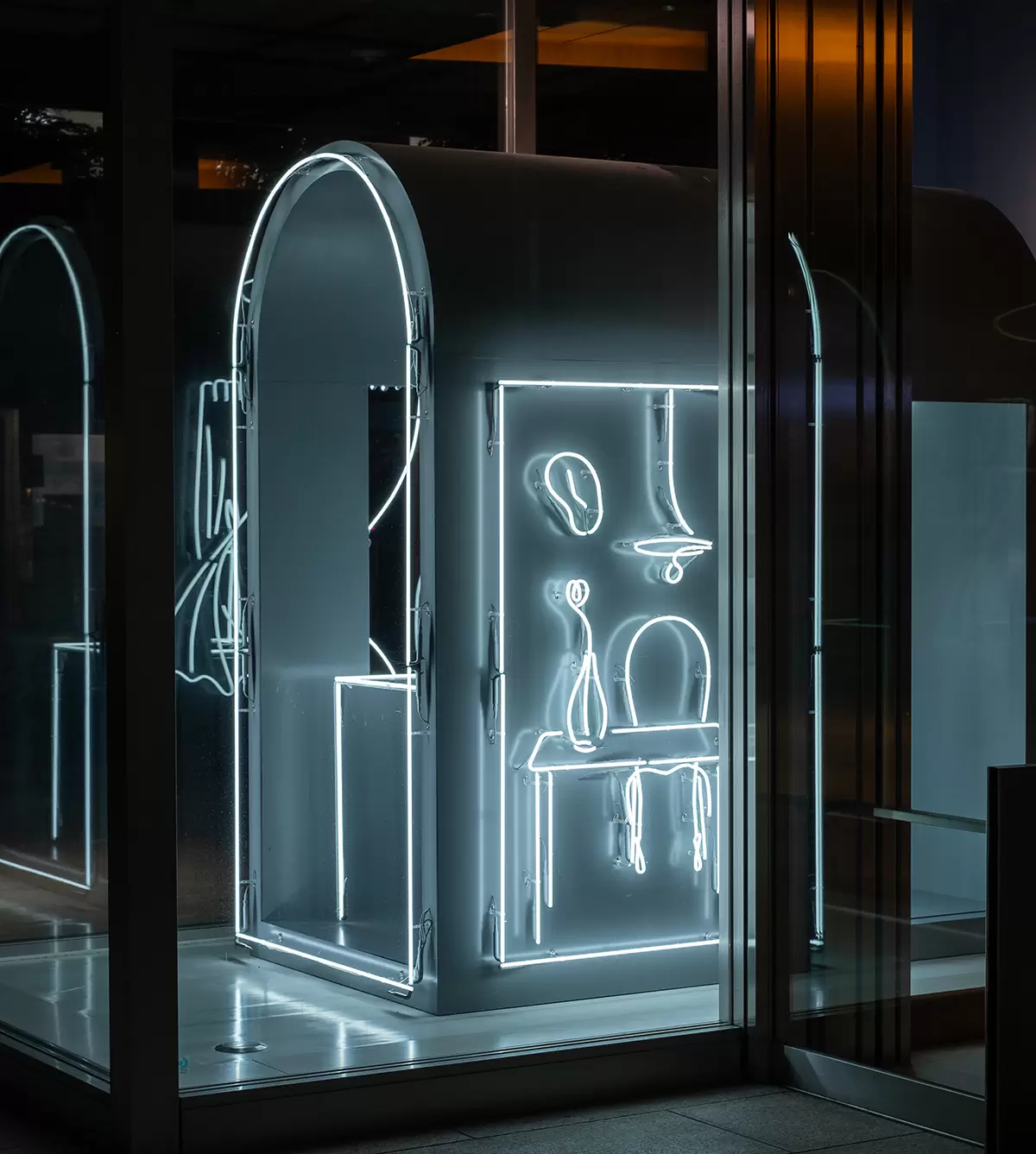
Architecturally, a show window is a space that exists within a building while simultaneously serving as a point of connection to the outside world — a kind of margin within the urban landscape.
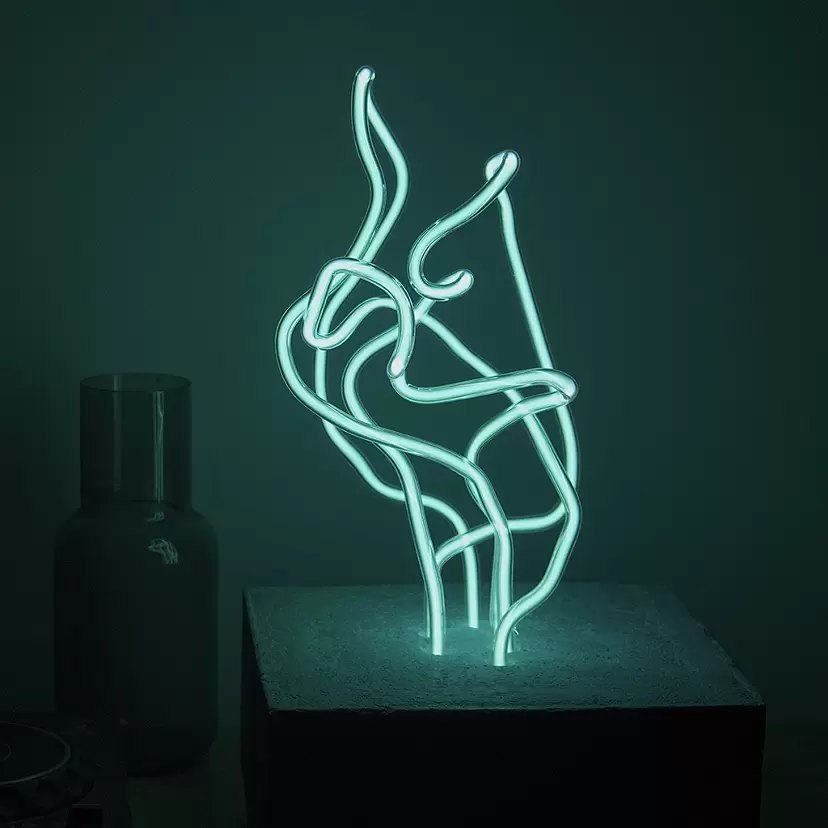
This installation expresses the unique charm of such a space through special lines drawn with neon, harmonizing opposing elements such as inside/outside, plane/volume, and front/back.
The soft yet sharp glow of the neon extends beyond the frame of the show window, spreading outward into the city and creating a transient urban landscape shared with the people who pass by.
ARTIST VOICE
Q: What inspired you to apply?
I was drawn to THE GALLERY for its spacious, three-sided glass facade and its prime location, where many people would have the opportunity to encounter my work.
The neon pieces I usually create tend to be more two-dimensional, but this three-dimensional space inspired me to take on a new challenge — to explore an expression I had never attempted before. That excitement led me to apply.
Q: How did you develop the concept for the project?
I focused on the role and uniqueness of the show window as an urban space. Although it exists within a building, it opens directly to the outside — a boundary space full of potential. I wanted to express the allure of this in-between place through a site-specific work.
The motif of a room emerged as a symbol of interior space, and from there, the idea of a curtain placed outside the room took shape — a playful device that turns the external view of the show window into an interior. The overall concept evolved naturally from this spatial and thematic inversion.
Q: What message or intention did you put into the work?
I have a deep attachment to every stage of working with neon — from bending and shaping the glass tubes to lighting them for the first time. One of the main challenges was finding ways to reflect my technical originality within the artistic expression.
A neon tube is essentially a single line, yet during fabrication it is manipulated across both the front and back surfaces. This quality — both planar and sculptural — is unique to neon. I sought to embody that duality by creating a work that expands from two-dimensional forms into three-dimensional space. From a technical standpoint, it was a demanding yet highly rewarding process.
Q: How did you feel after completing the work?
Once installed, the three glass walls reflected one another, expanding the space like a hall of mirrors and creating unexpected visual effects. I was thrilled to see these accidental interactions come to life and to successfully realize the piece.
During installation, I could feel the liveliness of the city and the flow of people passing by the show window — it reminded me how special this exhibition site truly is. I was excited that the glow of the neon could become part of the city’s landscape.
This was one of my largest works to date, and I’m deeply grateful to everyone who supported the production, as well as to the organizers for selecting my proposal and giving me this invaluable opportunity.
EVALUATION
Tomio Koyama
(President, Tomio Koyama Gallery Co., Ltd. / Vice Representative Director, Japan Contemporary Art Dealers Association)
A room drawn in a single stroke of neon glows in the night city, its reflections on the glass surface extending outward and connecting to the city — like a transparent, futuristic space. The three-dimensional image seen from the front also appears as a two-dimensional version on the sides, creating a slightly disorienting yet fascinating shift in perspective. Even the curtain fluttering in the breeze feels surprisingly pop and lighthearted — an everyday space beautifully transformed. It’s a wonderful work.
Kazuyuki Hashimoto
(Professor, Department of Design, Faculty of Fine Arts, Tokyo University of the Arts / Project Leader, Setouchi Branch of the Art and Future Research Center)
The composition of the space — blurring the boundary between inside and outside — is skillfully calculated, and the nostalgic aura of neon adds great depth. It makes you wonder, “Wait, what does the inside look like again?” and keeps you engaged through its visual playfulness. The mysterious feeling on the side where the curtain moves gently is particularly mesmerizing — I found myself watching it again and again. There’s also a clever joy in how the piece embraces our modern tendency to immediately take out our smartphones and capture the moment.
Masamichi Toyama
(President, Smiles Co., Ltd. / CEO, The Chain Museum Co., Ltd.)
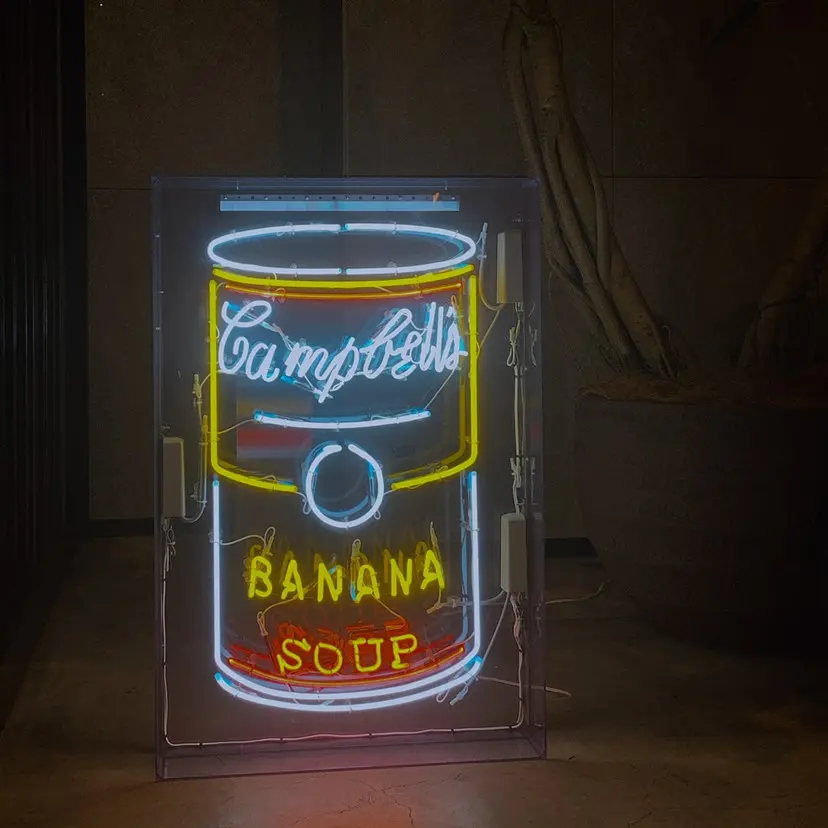
Cattelan’s banana taped to the white cube is still fresh in memory — and if one starts saying that the banana recalls Warhol’s Velvet Underground, that’s probably just what the artist intended. Without overthinking, the purest and happiest way to engage with this work might be to simply buy it, place it in your own bar — or even open a new one just for it — and let it spark conversations among tipsy guests.
Hiroaki Sakamoto
(Director, Tokyo Division, The Hakone Open-Air Museum Foundation)
Since its debut in early 20th-century Paris, neon has been widely used for signage, yet here it emits an organic glow that feels both nostalgic and strikingly fresh today. The furniture forms, outlining a room-like structure both inside and out, are drawn with soft, luminous curves that overlap and transform with changing viewpoints. As I gazed at the piece, I felt as if I were stepping into the room itself — gently led into a nostalgic time, intertwined with the shifting cityscape around it.
展覽資訊
- 過去的展覽
- Brillia Art Award Cube 20242024.07.01 - 2025.01.31
藝術家

Artist / Designer
1991年、東京生まれ。早稲田大学社会科学部卒業。 ネオン管の特性を活かした作品制作やバーナーワークを手がけ、近年では吹きガラスの技法も応用したネオン作品の制作に取り組んでいる。日本有数のネオン管技工士に認定され、ネオンサイン技術の継承にも携わる。「光をメディウムとする表現」「手工芸の技術」を軸に、光が生み出す情緒性と光を支える科学技術の双方にアプローチしている。 <受賞歴> 2024年 / SICF25 EXHIBITION部門 廣川玉枝賞 2024年 / Brillia Art Award 2024 入選 2021年 / LUMINE meets ART AWARD 2020-2021 オーディエンス賞 <略歴> 2014年 早稲田大学社会科学部卒業 1991年 東京都に生まれる <活動歴> 2024年 / 個展「Hand in hand」(YUVAN Gallery / 東京・渋谷) 2024年 / LUMINE ART FAIR(Lumine 0 / 東京・新宿) 2024年 / NAGOYA ART COLLECTION 2024(金山南ビル美術館 / 愛知・名古屋) 2024年 / 企画展 HARMONY – 用⇔美(ジルダールギャラリー / 愛知・名古屋) 2024年 / Brillia Art Award 2024入選展 (Brillia Lounge 「THE GALLERY」/東京・八重洲) 2024年 / SICF25(SPIRAL / 東京・表参道) 2023年 / 個展 「Diffusion」 (ギャラリーDiEGO / 東京・表参道) 2022年 / SICF23(SPIRAL / 東京・表参道) 2022年 / 『KAWAKYU ART Exhibition 2022』 (川久ミュージアム / 和歌山・南紀白浜)
查看藝術家信息

今後の作品制作費のため、ご支援いただいたお金は大切に使わせていただきます。